Walking into a Pilates class for the first time can feel genuinely overwhelming. The equipment looks unfamiliar, the language is different from any gym you have been to before, and everyone else seems to know exactly where to stand and what to do. That feeling is more common than most people admit, and it passes quickly.
Hong Kong has one of the most developed Pilates communities in Asia. There are studios across Central, Wan Chai, Tsim Sha Tsui and beyond, offering everything from mat classes to Reformer sessions to specialist programmes for rehabilitation and prenatal care. Knowing how to navigate those options as a beginner makes the difference between a positive first experience and an expensive mistake.
This guide covers everything you need before your first class, including what Pilates actually develops, how to choose between the different formats, what to look for in a Hong Kong studio, and why the instructor’s certification matters more than most people realise.
What Pilates Actually Does to Your Body
Pilates was developed in the early twentieth century by Joseph Pilates, a German physical trainer who designed the method originally to rehabilitate injured dancers and athletes. The system has since evolved considerably, but the foundational principle remains: movement that is precise, controlled and originating from a stable core produces far better outcomes than movement that is large, effortful and driven by the superficial muscles.
When you attend a Pilates class in Hong Kong consistently, the changes you notice first are usually postural. Your spine begins to sit differently at your desk. Your shoulders settle back without conscious effort. The tightness in your lower back that you had accepted as normal starts to reduce. These are not incidental side effects. They are the direct result of the deep stabilising muscles learning to engage correctly for the first time.
Over time, Pilates builds functional strength that transfers to daily life in ways that conventional gym training often does not. The method does not isolate muscles. It trains the body to move as a coordinated system, which is why so many physiotherapists and orthopaedic specialists recommend it alongside conventional rehabilitation.
Mat Pilates vs Reformer Pilates: Which Should You Start With?
This is the first real decision for any beginner attending Pilates classes near them in Hong Kong. Both formats are effective, but they work differently and suit different goals and starting points.
Mat Pilates uses only bodyweight and occasionally small props like resistance bands, Pilates circles and foam rollers. It is accessible, requires no equipment and is an excellent foundation for understanding the movement principles that underpin the entire system. The limitation is that progress can plateau relatively quickly without the feedback and resistance that equipment provides.
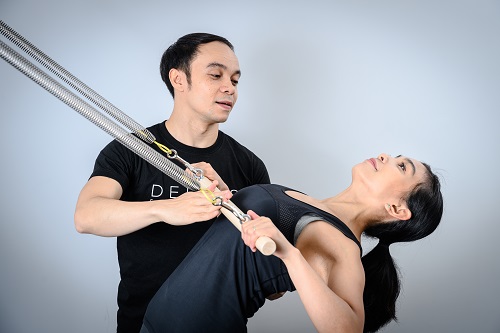
Reformer Pilates uses a sliding carriage with adjustable spring resistance. The machine provides immediate tactile feedback on movement quality, which accelerates learning significantly. It also allows the instructor to challenge each student at a different intensity level within the same class, which is why group Reformer classes can accommodate a wide range of experience levels simultaneously.
For most beginners in Hong Kong, starting with Reformer Pilates classes at DEFIN8 FITNESS gives a faster and more measurable progression than mat only training, particularly if you have a desk job, a history of back pain or a previous injury.
What to Look for When Choosing a Pilates Studio in Hong Kong
The quality of instruction is the single most important variable in your Pilates experience. The method requires a level of anatomical understanding and cueing precision that takes years to develop, and the difference between a well trained instructor and someone who simply completed a short course is immediately apparent in a session.
When evaluating a Pilates studio in Hong Kong, check the following:
- Instructor certifications: Look for Balanced Body, STOTT Pilates, Polestar or equivalent internationally recognised qualifications
- Class sizes: Smaller groups allow the instructor to provide individual corrections, which is essential for beginners
- Assessment process: Reputable studios offer or require an initial assessment before placing you in a class
- Specialist programmes: A studio that offers rehabilitation, prenatal and postnatal Pilates has instructors with a broader depth of training
- Studio environment: Equipment should be well maintained and the space should feel welcoming rather than intimidating
Your First Class: What Actually Happens
A typical beginner Reformer Pilates class in Hong Kong runs for fifty to sixty minutes. You will be shown how to adjust the carriage and springs before the class begins, and the instructor will demonstrate each exercise before leading the group through it.
The first few sessions focus heavily on the foundational movements: the neutral spine position, how to engage the deep abdominals without gripping the outer muscles, how to breathe in coordination with movement, and how to stabilise the pelvis during leg and arm movements. These fundamentals feel simple but they are not. They are the building blocks that everything else in the Pilates system depends on.
Expect to feel some muscle soreness after your first two or three sessions, particularly in the deep abdominals and the muscles around the hips. This is normal and decreases as your body adapts. Most beginners notice a meaningful change in how they carry themselves within three to four weeks of consistent attendance.
If you are based in Central Hong Kong, DEFIN8 FITNESS on Wellington Street offers group Pilates classes with an approach that has been rated among the best in the city by multiple independent publications.
How Often Should a Beginner Attend?
Two to three sessions per week is the recommended frequency for a beginner looking to build a foundation quickly. Pilates is a skill based practice and the neural adaptations that drive early progress require regular repetition to take hold.
One session per week will produce results but the progress is noticeably slower. The body needs enough repetition within a short enough timeframe for the new movement patterns to become automatic. Once they do, the benefits extend well beyond the studio into your daily movement, posture and recovery from other physical activities.
Final Thoughts
Starting Pilates in Hong Kong is one of the most practical fitness decisions you can make, particularly if you work long hours at a desk, have an old injury that has never fully resolved, or are simply looking for a method that builds real physical capability rather than just calorie expenditure.
The key is choosing a studio and instructor that will give you the proper foundation from the beginning. The principles are subtle and the technique matters enormously. Getting them right from the first class saves months of having to unlearn habits that develop when the foundational movements are rushed or poorly taught.
For a full class schedule and to book your first session, visit defin8fitness.com and see what is available at the Central and Wan Chai locations.
| Ready to start? Book your first Pilates class at DEFIN8 FITNESS today.View the full class schedule at defin8fitness.com |