
Hip pain is one of the most prevalent physical complaints among Hong Kong adults across all age groups. In younger adults it tends to present as hip impingement or labral irritation from the combination of prolonged sitting and high impact recreational activity. In middle aged adults it is more often the result of progressive tightening of the hip capsule and the deep rotators from years of inadequate hip mobility training. In older adults it may involve degenerative changes to the hip joint itself.
Across all of these presentations, Pilates offers a specific and evidence-based contribution to recovery and pain management that physiotherapy alone often does not fully address. This guide explains why, and what a Pilates-based approach to hip pain rehabilitation involves in practice.
Why Hip Pain Is So Common in Hong Kong
The hip joint requires a balance of mobility and stability that the lifestyle of the average Hong Kong adult consistently undermines. Extended sitting shortens the hip flexors and reduces the daily range of motion that the hip capsule and surrounding connective tissue require to maintain their extensibility. The deep hip rotators, which are responsible for the stability of the femoral head within the acetabulum during movement, become progressively weaker and less responsive in the absence of specific training.
The consequence is a hip joint that is simultaneously tight and unstable: restricted in the ranges it can comfortably access and insufficiently controlled in the ranges it does access. This combination creates the conditions for labral irritation, impingement, and the progressive degenerative changes that produce more significant hip pathology over time.
How Pilates Addresses Hip Dysfunction
Pilates targets the hip dysfunction pattern described above through two simultaneous mechanisms: mobility restoration through loaded range of motion work and stability development through deep hip rotator and glute activation.
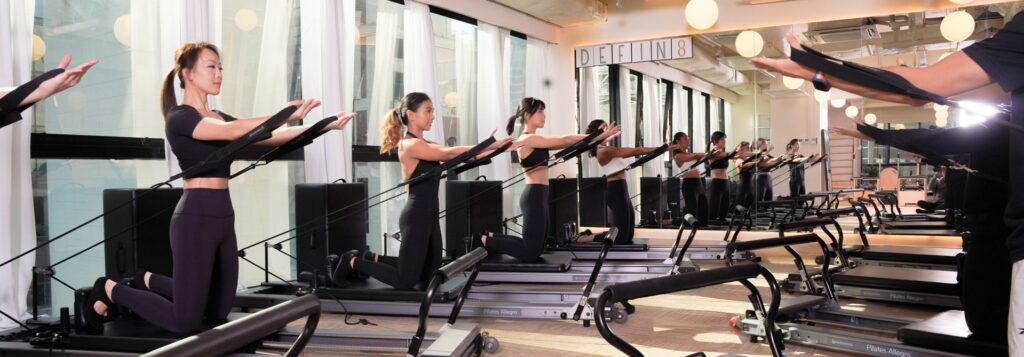
The Reformer is particularly effective for hip rehabilitation because the spring resistance allows the hip to be loaded through positions and ranges that bodyweight alone cannot access safely in the early stages of rehabilitation. The footbar and carriage system creates supported positions from which the hip can be moved through its full available range without the compression that weight bearing positions produce.
The deep hip rotator activation in Pilates, particularly the piriformis, obturator internus and gemelli, directly addresses the stability deficit that makes the hip joint vulnerable to irritation and progressive damage. These muscles are rarely specifically trained in conventional exercise programmes and their weakness is a primary driver of many hip pain presentations.
Private Pilates rehabilitation sessions at DEFIN8 FITNESS are the most appropriate starting format for clients with significant hip pain, as the individual assessment ensures the programme targets the specific pattern driving each client’s presentation.
Hip Impingement and Pilates: What to Expect
Hip impingement, or femoroacetabular impingement, is one of the most commonly diagnosed hip conditions in Hong Kong’s active adult population. It involves compression of the soft tissue structures around the hip joint in certain positions, typically at the end range of hip flexion and internal rotation.
Pilates for impingement focuses on developing the muscular control that positions the femoral head optimally within the acetabulum during movement, reducing the compression that produces symptoms. The exercises that achieve this work the external hip rotators through their inner range and develop the gluteal activation that guides the femur during hip flexion.
Progress with impingement through Pilates is typically gradual and non-linear. There will be sessions that produce more discomfort than others and positions that require consistent avoidance until the underlying stability has improved sufficiently to access them without compression.
After Hip Replacement: Returning to Movement With Pilates
Hip replacement surgery is increasingly common among Hong Kong adults over sixty, and the return to movement after replacement involves specific considerations that not all exercise formats are equipped to address appropriately.
Pilates, in the hands of an instructor with rehabilitation training, is particularly well suited to post-hip replacement exercise because the equipment allows controlled, low-impact loading through the hip’s new range in positions that protect the replacement in the early recovery period.
The deep core work in Pilates also directly supports the hip replacement recovery by developing the muscular stability around the new joint that is needed for safe, confident weight bearing. Many post-replacement clients in Hong Kong report that Pilates was the exercise format that finally allowed them to feel confident and capable in daily movement again.
Final Thoughts
Hip pain that has become an accepted feature of daily life in Hong Kong does not have to remain so. Whether the presentation is impingement, labral irritation, capsular tightening or post-surgical recovery, Pilates offers a specific and progressive approach to restoring mobility, developing stability and returning to full function.
The key is working with an instructor who understands the specific anatomy and mechanics of the hip and can design a programme around your particular presentation rather than a generic approach.
Contact DEFIN8 FITNESS to discuss your hip pain history and start a rehabilitation programme designed around your specific needs.
| Address your hip pain with expert Pilates rehabilitation at DEFIN8 FITNESS Hong Kong. Book a rehabilitation assessment at defin8fitness.com/pilates-rehabilitation |