
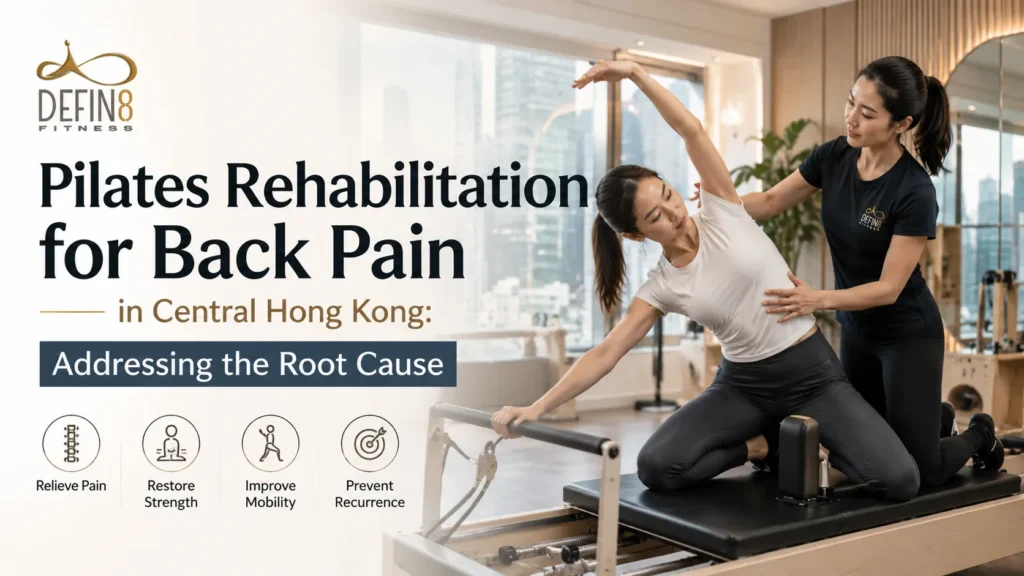
Back pain is the most common physical complaint among Central Hong Kong’s professional population, and it is produced by that population’s working life with a reliability that has nothing to do with genetics or bad luck. The specific combination of sustained sitting, high cognitive demand, limited movement opportunity and the chronic low-grade physical tension of high-pressure working environments creates the conditions for lumbar disc loading, deep stabiliser inhibition and the cascading compensation patterns that produce the back pain most Central professionals have simply accepted as a feature of their working week.
Pilates rehabilitation in Central Hong Kong at a certified level addresses this pattern specifically, and the evidence for its effectiveness for the type of back pain that desk-based professional life produces is among the most robust in the exercise medicine field. This guide explains why the approach works, what the rehabilitation programme at DEFIN8 FITNESS on Wellington Street involves and who in Central Hong Kong is most likely to benefit from it.
Why Central Hong Kong’s Working Environment Produces Back Pain
The lumbar spine is designed for a combination of movement and load. It is not designed for sustained static loading in a single position for eight to ten hours per day. When the lumbar spine is held in sustained flexion, as sitting consistently produces, the intervertebral discs experience posterior loading that progressively stresses the posterior annulus fibrosus. The deep lumbar stabilisers, the multifidus and transversus abdominis, which are responsible for protecting the disc and the vertebral joints under dynamic load, progressively inhibit in the absence of the varied loading that movement provides.
The result, after months and years of this pattern, is a lumbar spine that is simultaneously compressed from sustained loading and inadequately stabilised by the muscles that should protect it. The superficial muscles, the erector spinae and quadratus lumborum, compensate by maintaining a state of chronic protective tension. This tension is what most Central professionals experience as lower back tightness that never fully resolves regardless of how much they stretch.
Stretching does not resolve this pattern because the tightness is neuromuscular rather than structural. The superficial muscles are contracting protectively because the deep stabilisers are not engaging adequately. Releasing the superficial tension without restoring the deep stabiliser function produces temporary relief followed by return of the same pattern.
How Pilates Rehabilitation Addresses This Specifically
Pilates rehabilitation targets the deep stabiliser inhibition directly. The foundational exercises in the rehabilitation programme require the transversus abdominis and multifidus to engage in the precise coordination pattern that the lumbar spine needs for safe, pain-free movement. This is not a matter of doing more abdominal exercises. It is a matter of reactivating specific muscles in a specific sequence through precise, low-load movement that bypasses the protective guarding response that pain has established.
The Reformer spring resistance is particularly valuable in a rehabilitation context because it allows the exercise load to be calibrated precisely. A spring setting that provides just enough resistance to require deep stabiliser engagement without exceeding the recovering tissue’s tolerance is a level of precision that bodyweight exercise alone cannot provide consistently.
The progression from this initial low-load deep activation through to functional movement patterns that the client needs for daily life and professional activity is managed by the instructor’s ongoing assessment of how the client’s presentation is responding, not by a fixed programme timeline.
Private Pilates rehabilitation sessions at DEFIN8 FITNESS on Wellington Street, Central are available across morning and evening time slots with certified rehabilitation instructors.
What a Pilates Rehabilitation Programme in Central Hong Kong Involves
The Initial Assessment
Every rehabilitation programme at DEFIN8 FITNESS begins with an individual assessment that is specifically oriented toward understanding the neuromuscular presentation rather than the structural diagnosis alone. The instructor assesses movement patterns, identifies inhibited deep stabilisers, evaluates the compensation patterns that have developed and designs the programme around these specific findings rather than around a generic back pain protocol.
The Early Sessions
The early sessions focus almost entirely on reconnecting with the deep stabilising system through breath-coordinated activation exercises. These sessions feel deceptively gentle given the level of pain the client may have been experiencing. That is not a sign that the work is insufficient. It is a reflection of the therapeutic principle that the deep stabilisers must be reactivated carefully, without triggering the protective guarding response that loading too quickly would produce.
The Progressive Loading Phase
As deep stabiliser engagement becomes consistent and the pain response reduces, the programme introduces progressive loading through movement patterns that challenge the stabilising system within the recovering tissue’s tolerance. Exercises are progressively loaded toward the functional movement demands of the client’s working life: sustained sitting with active stabilisation, transitioning between postures, carrying and lifting patterns.
What the Evidence Shows About Pilates for Back Pain
The clinical research on Pilates for chronic lower back pain is one of the most extensively developed evidence bases in exercise medicine. A 2015 systematic review in the Journal of Orthopaedic and Sports Physical Therapy examined twelve randomised trials and found strong evidence that Pilates produces significant reductions in pain and disability compared to general exercise and is comparable to physiotherapy for chronic lower back pain. A 2017 meta-analysis reviewing sixteen studies reached the same conclusion.
The research also shows that the gains from Pilates are more durable than those from general exercise. The movement pattern changes that Pilates produces are maintained independently once established, which is why clients who complete a rehabilitation programme and attend maintenance sessions periodically consistently outperform those who return to unstructured exercise after discharge.
Final Thoughts
Back pain in Central Hong Kong is a predictable consequence of Central working life and it is addressable through the specific intervention that Pilates rehabilitation provides for its neuromuscular drivers. The evidence is strong, the mechanism is clear and the programme at DEFIN8 FITNESS on Wellington Street has been delivering results for Central’s professional community since 2016.
The most important decision is beginning the programme rather than continuing to manage a condition that is both progressive and unnecessary given the availability of an evidence-supported solution within ten minutes walk of most Central office buildings.
Book a rehabilitation assessment at DEFIN8 FITNESS Central and begin addressing your back pain at its actual cause.
| Book a Pilates rehabilitation assessment in Central Hong Kong at DEFIN8 FITNESS.Enquire at defin8fitness.com/pilates-rehabilitation |