
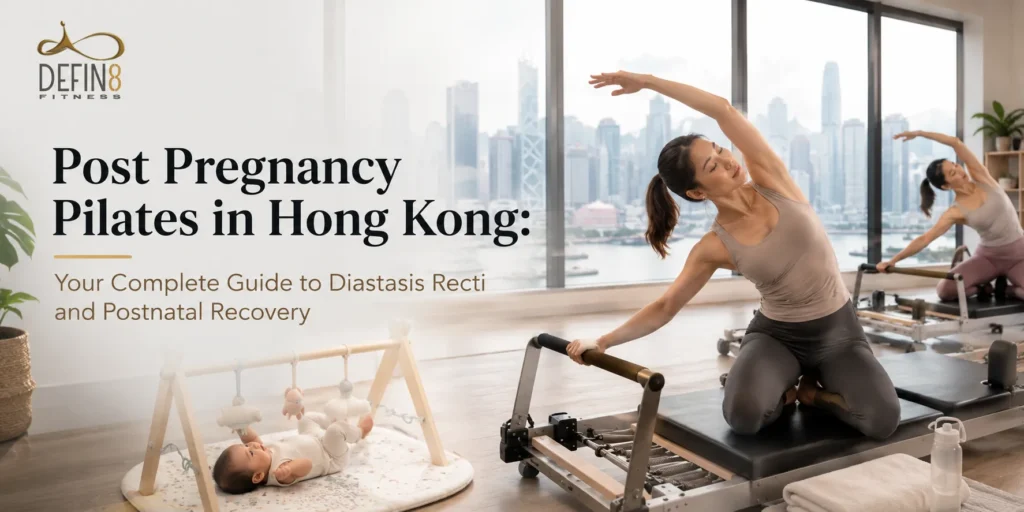
The weeks after birth are a period that Hong Kong’s maternity care system handles well in terms of acute medical monitoring and significantly less well in terms of practical physical recovery guidance. The six-week check confirms that healing is progressing normally. It does not evaluate diastasis recti, assess pelvic floor function, check deep core activation or advise specifically on which exercises are safe and which are counterproductive at this stage.
Most new mothers in Hong Kong leave the six-week check with a general green light for exercise and no specific guidance about what that should look like given what their body has been through. Many then return to the exercise they were doing before pregnancy and wonder why their core does not function the way it did, why their lower back hurts in a way it did not before, and why their abdominal appearance has not improved despite months of effort.
The answer to all of those questions is usually diastasis recti, pelvic floor dysfunction or both. This guide explains what these conditions are, why the standard advice does not address them adequately and how certified post pregnancy Pilates in Hong Kong provides the structured recovery that new mothers in Central Hong Kong genuinely need.
What Diastasis Recti Is and Why It Matters Beyond Appearance
Diastasis recti is the widening of the linea alba, the connective tissue that runs vertically through the centre of the abdomen, as the two sides of the rectus abdominis separate during pregnancy to accommodate the growing uterus. It occurs to some degree in the majority of women by the end of the third trimester.
The condition is frequently discussed in terms of the physical appearance of the abdomen after birth: the soft midline, the persistent belly that does not respond to exercise. These are real and valid concerns. What is less commonly discussed is the functional impact: the chronic lower back pain that many new mothers accept as normal, the pelvic instability that makes lifting and carrying uncomfortable, the bladder control issues that affect daily life and the persistent sensation that the core is not generating the stability it used to.
These functional consequences are the result of the linea alba’s load-bearing function being compromised. When this tissue is stretched and weakened, the deep core container loses its structural integrity, which produces the symptoms described above through a neuromuscular mechanism rather than a structural one.
Why Standard Postnatal Exercise Advice Often Makes Diastasis Worse
The exercises most commonly recommended for abdominal recovery after birth, sit-ups, crunches, double leg raises and conventional plank holds, are specifically counterproductive in the presence of a significant diastasis. These exercises increase intra-abdominal pressure in a direction that stresses the weakened linea alba outward rather than encouraging its approximation inward.
The visible coning or doming that many new mothers notice along the midline of their abdomen when they attempt these exercises is direct physical evidence that the exercise is loading the linea alba in the wrong direction. This pattern, if continued, does not improve the diastasis. It maintains or worsens the separation.
Post pregnancy Pilates rehabilitation specifically avoids this pattern in the early stages and replaces it with exercises that activate the transversus abdominis, which is the primary muscle responsible for drawing the linea alba toward the midline and restoring its tension.
The postnatal Pilates rehabilitation programme at DEFIN8 FITNESS includes a diastasis assessment at the beginning of every new client’s programme and designs the exercise prescription entirely around the specific findings of that assessment.
Pelvic Floor Rehabilitation After Birth
Pelvic floor dysfunction after birth is more common than the clinical conversation around it suggests. Stress urinary incontinence affects a significant proportion of postnatal women in Hong Kong and is frequently accepted as a normal consequence of birth rather than a treatable condition. It is treatable, and the most effective approach to treating it is the integrated pelvic floor and deep core rehabilitation that post pregnancy Pilates provides.
Generic Kegel exercises, which are the standard advice for postnatal pelvic floor recovery, produce variable outcomes because they are performed without guidance on whether the muscles are being activated correctly or in the appropriate coordination with the breath and deep abdominals. Many women who have been doing Kegels consistently since birth find that their pelvic floor symptoms have not improved because the exercises are being performed in isolation from the system they belong to.
Pilates-based pelvic floor rehabilitation integrates the pelvic floor with the transversus abdominis, the breath and the hip stabilisers in coordinated movement patterns that restore the functional relationship between all of these structures. This integrated approach consistently produces better outcomes than isolated exercise prescription because it trains the pelvic floor as part of the whole system.
The Postnatal Pilates Programme at DEFIN8 FITNESS Central
When to Start
For uncomplicated vaginal births, gentle breath and pelvic floor awareness work can begin within days of delivery. Progressive Pilates rehabilitation typically starts between six and eight weeks following medical clearance. For caesarean deliveries, direct abdominal loading is deferred to eight to twelve weeks or until the scar tissue has stabilised sufficiently.
The Reconnection Phase
The first several sessions focus entirely on reconnecting with the deep core and pelvic floor through breath-coordinated exercises that produce no intra-abdominal pressure. This phase can feel frustratingly gentle for mothers who are eager to return to previous fitness levels, but rushing past it consistently produces setbacks.
This is the phase that distinguishes the DEFIN8 FITNESS postnatal programme from both general group fitness and generic postnatal exercise classes: the reconnection work is taken seriously as a prerequisite for all subsequent loading rather than being bypassed in favour of more visible effort.
The Progressive Loading Phase
From the reconnection foundation, the programme builds progressively through functional movements that load the core and pelvic floor in the coordinated patterns needed for daily life: lifting, carrying, standing from sitting, walking and eventually running and higher impact activity for those who want to return to those demands.
Final Thoughts
Post pregnancy Pilates in Hong Kong, when delivered by a certified specialist, is the most structured and evidence-supported approach to postnatal recovery available in the city. The diastasis rehabilitation, pelvic floor recovery and progressive core rebuilding that a properly designed programme provides are not available from general group fitness or generic postnatal exercise advice.
The decision to pursue certified postnatal Pilates is not about fitness vanity. It is about functional recovery from a significant physical process that deserves more than a six-week check and a general green light.
Contact DEFIN8 FITNESS to discuss your birth experience, your timeline and which programme format is appropriate for your current recovery stage.
| Start your postnatal Pilates recovery at DEFIN8 FITNESS Central Hong Kong.Book at defin8fitness.com/pre-post-natal |