The perception that Pilates is primarily a recovery or wellness practice, suitable for new mothers and people with back pain but not relevant to serious athletic performance, is one that has been comprehensively dismantled by the sports science community over the past two decades.
Professional athletes across swimming, tennis, golf, rugby, gymnastics, martial arts and running now routinely include Pilates in their conditioning programmes, not as an afterthought but as a primary tool for developing the movement quality, injury resilience and physical longevity that their sport demands.
In Hong Kong, a growing number of competitive athletes from amateur to elite level are incorporating Pilates into their training. This article explains why the method has earned that place and what specifically it provides that sport specific conditioning does not.
The Movement Quality Gap in Athletic Training
Most sport specific conditioning programmes are excellent at developing the physical capacities that a particular sport demands: explosive power, speed, sport specific strength, cardiovascular endurance. What they are less consistently good at is developing the foundational movement quality that determines how efficiently and safely those capacities are expressed.
Movement quality, in the context of athletic performance, refers to the coordination of the deep stabilising system, the sequencing of force through the kinetic chain and the maintenance of structural integrity under load. Athletes who have developed exceptional sport specific strength without a corresponding foundation of movement quality are efficient within the specific movement patterns their sport has trained but become vulnerable when those patterns are disrupted, which is precisely the situation that most injuries occur in.
Pilates addresses this gap directly. The method develops the deep stabilising system, teaches precise force sequencing through the trunk and trains the body to maintain structural integrity through a wide range of movement patterns under varying loads.
Specific Athletic Populations That Benefit Most
- Swimmers: The shoulder stability, rotational core strength and spinal articulation that Pilates develops directly translates to more efficient stroke mechanics and reduced shoulder injury risk
- Tennis and racquet sport players: Rotational power in tennis originates from the posterior chain and deep trunk rotators, both of which Pilates trains specifically. The deceleration demands of the post-stroke phase also require the deep stabilising system that Pilates builds
- Golfers: The golf swing is one of the most technically demanding rotational movements in sport. Pilates develops thoracic mobility, deep rotator strength and the precise sequencing from hips through trunk to shoulder that determines swing quality
- Runners: Core stability during the single leg stance phase of running is a primary determinant of running economy and injury risk. Pilates specifically trains the hip and trunk stability that the single leg stance requires
- Martial artists and combat sport athletes: The three dimensional movement demands of grappling, striking and evading require exactly the kind of full body coordination and proprioceptive awareness that Pilates develops
- Cyclists: The spinal extension demands of a sustained aero position, combined with the repetitive asymmetrical loading of pedalling, create the kind of postural and movement pattern stress that Pilates rehabilitation specifically addresses
Pilates as an Injury Prevention Tool
The movement quality that Pilates develops is protective against injury not just as an abstract principle but through specific mechanisms that reduce the injury risk associated with athletic training and competition.
Most athletic injuries occur not during the intended movement but in the moments of deviation from it: the ankle that rolls on an uneven surface, the hamstring that is loaded beyond its eccentric capacity, the shoulder that is taken beyond its stabilised range. These deviations are controlled by the deep stabilising system and the proprioceptive awareness that allows the body to make rapid postural corrections.
Pilates training develops both of these capacities. Athletes who train consistently in Pilates show improved proprioceptive awareness, faster reactive stabilisation responses and a wider range of movement patterns within which they can maintain structural integrity. The practical effect is that they are less likely to be injured when their sport takes them to the edges of their trained movement patterns.
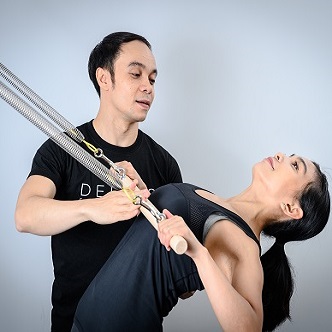
Private Pilates personal training at DEFIN8 FITNESS is available for athletes at all competitive levels who want a programme built specifically around their sport’s demands.
How to Integrate Pilates With Athletic Training
The integration of Pilates into an existing athletic training programme requires some planning to ensure the two programmes complement rather than interfere with each other. The primary consideration is timing: Pilates sessions that involve significant deep core fatigue should not immediately precede sport specific training sessions that also demand core stability.
For most athletes, two Pilates sessions per week during the training season and three during off-season or rehabilitation periods is a practical and effective frequency. Private sessions are almost always preferable to group classes for athletes because the programme needs to be sport specific to be maximally useful, which requires individual design.
The results that athletes consistently report include improved movement efficiency in their sport, reduced injury frequency, faster recovery from training loads and an extended competitive career relative to athletes of comparable training age who have not incorporated Pilates.
Final Thoughts
Pilates has earned its place in athletic training through consistent results across a wide range of sports and competitive levels. The movement quality it develops is not separate from athletic performance. It is foundational to it, and the athletes who recognise that consistently outperform the expectations of their training age and competitive history.
If you are a competitive athlete in Hong Kong looking to integrate Pilates into your training, private sessions with an instructor who understands your sport’s specific demands will produce the most targeted and relevant outcomes.
| Train smarter. Book private Pilates personal training for athletes at DEFIN8 FITNESS. Explore athlete training at defin8fitness.com |