Flexibility is consistently listed among the top goals of new fitness clients in Hong Kong, and consistently misunderstood as something that stretching alone can address. The connection between feeling stiff, doing more stretching and expecting to become flexible is intuitive but physiologically incomplete.
Pilates develops flexibility through a fundamentally different mechanism from static stretching, and the results are more durable, more functional and more applicable to how the body actually moves in daily life and physical activity. This guide explains why, and what Hong Kong clients can realistically expect from a consistent Pilates practice oriented toward mobility development.
Why Static Stretching Has Limited Long Term Effect
Static stretching produces short term increases in range of motion through neurological mechanisms. The muscle spindle, which monitors muscle length and triggers a contraction when the muscle is stretched too far or too fast, reduces its sensitivity during sustained stretching, allowing the muscle to lengthen temporarily.
This neurological adaptation is temporary. Within an hour of completing a stretching session, the muscle returns to its habitual length unless the stretch has been applied with enough frequency and duration to produce structural changes in the connective tissue. This takes far longer and more consistent application than most people’s stretching routines involve.
The additional problem is that flexibility without corresponding strength through the new range of motion is biomechanically unstable. Joints that are hypermobile without muscular control are more prone to injury than joints that are tight but stable. This is why some naturally flexible people are paradoxically more injury-prone than people with restricted but well controlled ranges of motion.
How Pilates Develops Functional Flexibility
Pilates develops flexibility differently from stretching in a specific and important way: it loads the muscles through their full available range of motion rather than simply elongating them passively. This eccentric loading, where the muscle lengthens while producing force against resistance, produces structural changes in the muscle tissue itself rather than just neurological changes in how sensitive the stretch reflex is.
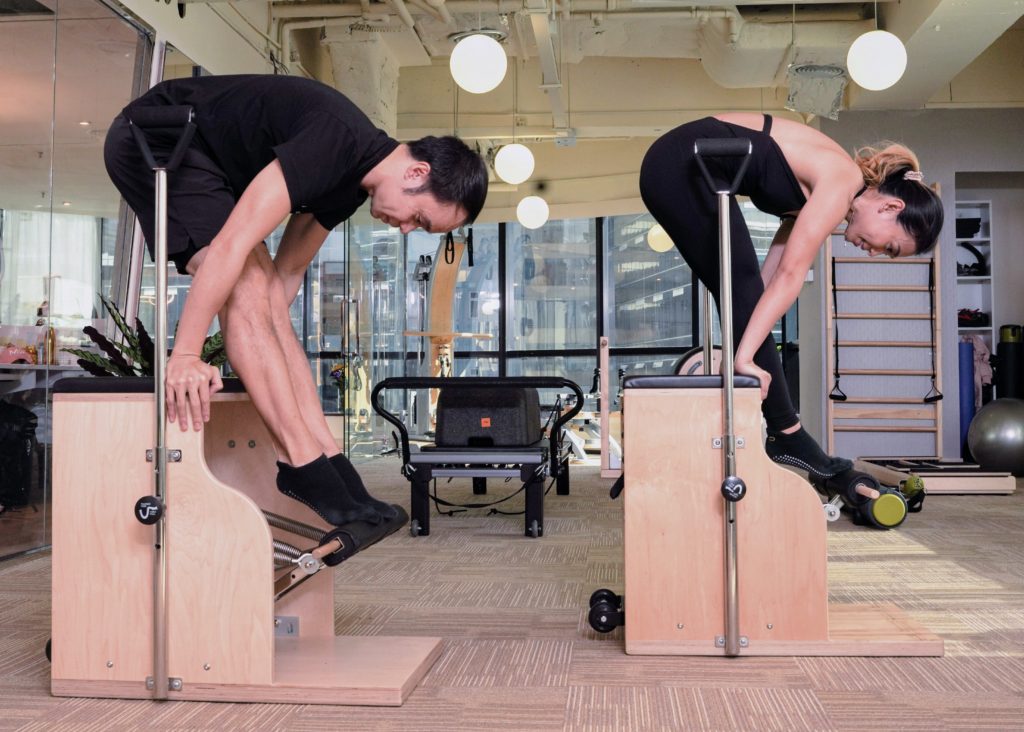
The Reformer is particularly effective for this approach because the spring resistance maintains load on the muscle throughout the full range of movement. An exercise like a hamstring stretch on the Reformer, where the leg is extended against spring resistance, produces simultaneous lengthening and strengthening of the hamstring that passive stretching cannot replicate.
For Hong Kong clients with specific flexibility restrictions related to injury, postural compression or sport, private Pilates sessions at DEFIN8 FITNESS allow the programme to target the specific restrictions rather than applying a generic class format.
GYROTONIC Training as a Complement to Pilates for Flexibility
For clients whose flexibility goals extend into the three dimensional range of motion of the spine, hips and shoulders, GYROTONIC training offers a dimension of mobility development that Pilates does not fully address.
Where Pilates develops flexibility primarily in the sagittal and frontal planes through controlled loading, GYROTONIC works through circular, three dimensional movement patterns that mobilise the joints in the full range that anatomy permits. The two methods work synergistically: Pilates builds the strength and stability foundation, GYROTONIC develops the full range expression of that foundation.
The GYROTONIC training programme at DEFIN8 FITNESS is delivered in private sessions by certified instructors and is particularly valuable for clients with restrictions related to spinal compression, hip dysfunction or shoulder mobility limitations.
Realistic Expectations for Flexibility Through Pilates
- Week four to six: First noticeable changes in range of motion during class exercises. The body begins to respond to the new movement demands
- Week eight to twelve: Daily life movements feel more fluid. The tightness that was habitual in the lower back and hips begins to reduce
- Month four to six: Measurable and visible range of motion improvement in the areas the programme has targeted. Other people begin to comment on changes in movement quality
- Month six to twelve: Structural change in the connective tissue that maintains the new range of motion without requiring continued active effort to access it
Final Thoughts
Flexibility developed through Pilates is qualitatively different from the temporary range of motion that stretching produces. It is functional, strong and durable because it is developed through loaded movement rather than passive elongation.
For Hong Kong clients who have been stretching consistently without the results they expected, adding Reformer Pilates to the routine provides the missing component: strength through range of motion that makes the flexibility permanent rather than temporary.
Explore the flexibility-oriented Pilates class formats at DEFIN8 FITNESS and book a session that works around your schedule.
| Develop real functional flexibility with Pilates at DEFIN8 FITNESS Hong Kong. Book your Pilates class at defin8fitness.com |