The most persistent misconception about Pilates in Hong Kong’s fitness community is that it is a flexibility practice that lacks the training stimulus to build meaningful strength. This misconception is understandable given how Pilates is often marketed, but it is physiologically inaccurate and leads many people to exclude one of the most effective strength training tools available from their weekly programmes.
Pilates is a strength training system. It was designed as one and it functions as one. The strength it builds is specific in character, targeting the deep stabilising muscles and the functional movement patterns that conventional resistance training consistently underserves. Understanding this specificity is what allows you to use Pilates intelligently within a complete strength programme rather than treating it as either a replacement for conventional training or an accessory that serves no serious training purpose.
How Pilates Builds Strength Differently From Conventional Training
Conventional strength training develops maximal force production in specific movement patterns, typically through concentric muscle contraction against progressively increasing external resistance. The outcomes are well known: improved maximal strength, increased muscle hypertrophy in the trained movement patterns and the hormonal and metabolic adaptations associated with heavy resistance work.
Pilates develops strength through different mechanisms. The spring resistance of the Reformer and other apparatus creates eccentric and isometric loading through a wider range of motion than conventional strength equipment allows. Eccentric loading, where the muscle lengthens while producing force, is the most effective stimulus for simultaneously developing muscle strength and length. This is why Pilates clients develop muscle definition and tone without the increase in muscle bulk associated with high-load concentric training.
The deep stabilising system, which conventional training rarely specifically targets, is the primary focus of Pilates strength work. The transversus abdominis, multifidus, deep hip rotators and rotator cuff are the muscles responsible for protecting the major joints and spine during loading. Their strength is the limiting factor in how much force the superficial muscles can safely generate, which is why their development through Pilates makes conventional strength training both safer and more effective.
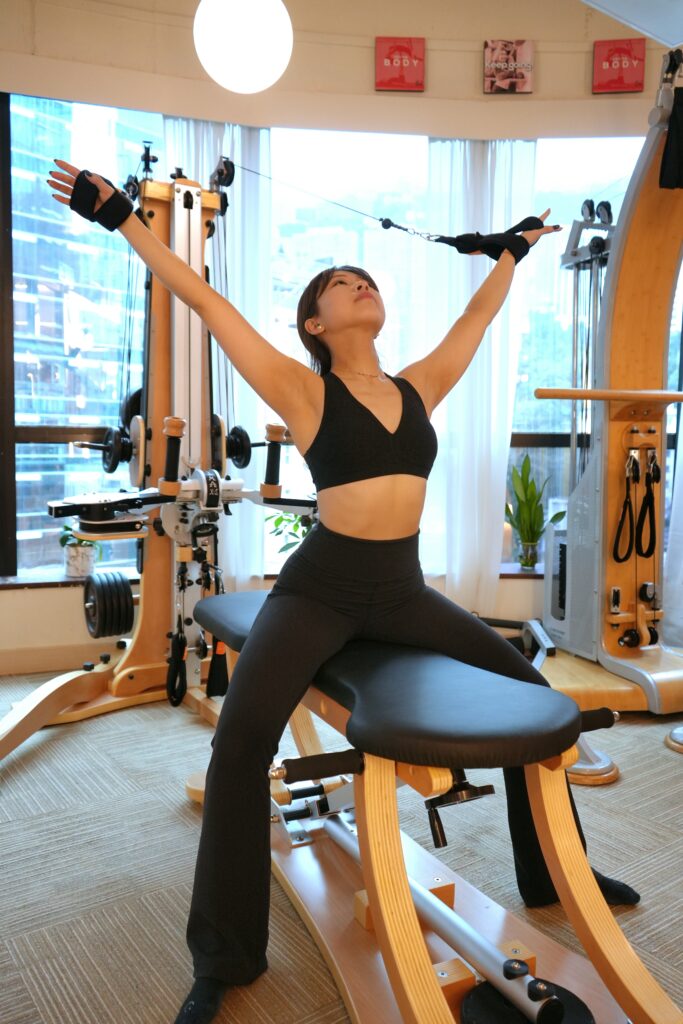
Private Pilates personal training sessions at DEFIN8 FITNESS can be specifically programmed for strength development goals, with the instructor designing a progression that targets the specific strength qualities your training requires.
Integrating Pilates With Conventional Strength Training in Hong Kong
The most effective strength training programmes for Hong Kong clients who want comprehensive physical development combine Pilates with conventional resistance training in a structure that uses each modality for what it specifically delivers.
Two to three Reformer Pilates sessions per week develop the deep stabilising system, the postural alignment and the eccentric strength that make conventional training safer and more effective. Two to three conventional resistance training sessions per week develop the maximal force production, muscle hypertrophy and metabolic adaptations that Pilates alone does not produce at comparable intensity.
The integration produces a training effect that neither modality achieves as completely on its own: the structural foundation of Pilates combined with the loading stimulus of conventional training produces a body that is both functionally strong in the movement patterns that daily life and athletic activity demand and maximally strong in the specific patterns that conventional training develops.
The Reformer as a Strength Training Tool
The Reformer’s spring resistance system deserves specific attention as a strength training tool because it operates differently from weights and machines in ways that produce specific strength outcomes.
The resistance in a Reformer exercise is provided by the springs, which increase in tension as they lengthen. This means that exercises become more challenging at the end of the range where the springs are most extended, which is typically where conventional weights become easiest due to the mechanical advantage of the joint angles. The Reformer therefore loads the muscles at the range of motion where they most need to develop strength, not where the physics of the equipment makes the exercise feel hardest.
This end-range loading through the spring system is particularly valuable for the shoulder girdle, hips and spine, where the ability to control and produce force at full range of motion is the most important determinant of injury resilience and functional movement quality.
The REFORM8 Infrared Reformer classes at DEFIN8 FITNESS combine the strength stimulus of the Reformer with the enhanced tissue responsiveness of the infrared environment, which allows the full range of strength work to be accessed from the beginning of each session.
Pilates for Strengthening Specific Populations in Hong Kong
- Post-rehabilitation strength rebuilding: After injury or surgery, Pilates provides the most appropriate progressive loading to rebuild the specific muscle groups that injury has weakened, without the compressive loading that conventional weights produce in the early recovery period
- Midlife strength maintenance: The muscle loss associated with ageing responds well to the eccentric loading of Pilates, which builds functional strength without the joint loading risks of heavy conventional training
- Pre-season athletic conditioning: Athletes using Pilates as their off-season or pre-season foundation develop the deep stabilising strength that makes the subsequent sport-specific strength work both safer and more transferable to performance
- Postpartum strength recovery: The progressive core and hip strengthening pathway in postnatal Pilates rebuilds the functional strength that pregnancy progressively reduces, through a loading approach that is appropriate for the postpartum body’s specific recovery requirements
Final Thoughts
Pilates is a strength training system that operates through mechanisms that conventional training does not replicate and that produces strength outcomes that conventional training does not consistently deliver. These are complementary truths, not competing ones.
The most physically capable people in Hong Kong’s active community are those who use Pilates as a foundation and complement to their other training rather than treating it as an alternative that competes with conventional strength work. The combination produces something that neither approach achieves alone.
Build the strength foundation that makes everything else more effective. Book Pilates personal training at DEFIN8 FITNESS and discuss your specific strength goals with the certified team.
| Build functional strength with Pilates personal training at DEFIN8 FITNESS Hong Kong. Book at defin8fitness.com/private-semi-private |